
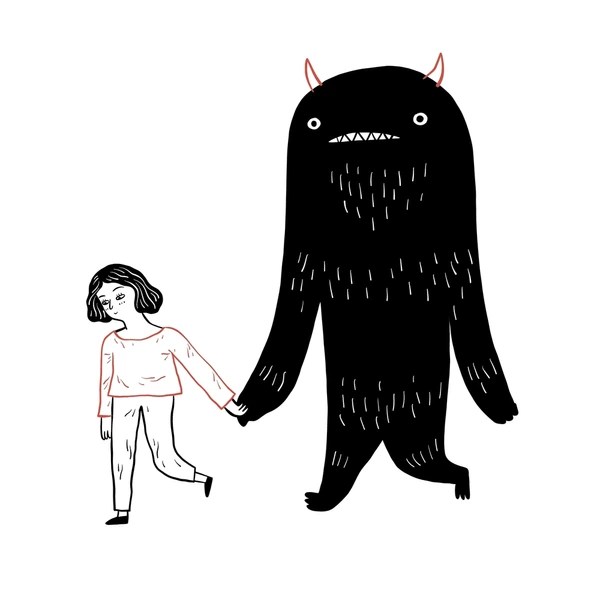
For years, as parents, we have been led to believe that what our children fear is darkness, and monsters often hiding under the bed or in the wardrobe. And for many years as a mum, I’ve been able to reassure them that the fear of the darker, quiet, night-time monster isn’t real. I’ve been able to ease, settle and soothe my children to sleep making them feel safe both physically and psychologically. I’m
Tragically, there’s now a new monster at night, which terrifies many children, paralysing them with fear and preventing them from feeling safe even in the sanctuary of their own homes and bedrooms. Goodbye Mike and Sully – Hello Anxiety!
More specifically, school related anxiety, or as it’s now called,Emotionally Based School Avoidance or EBSA. This dark, consuming, powerful monster, wraps itself around them, enveloping them in a deep, thick, dense cloud of fear and sadness. This monster makes them feel scared, worried, and have physical symptoms such as constant nausea and stomach pains, as well as feelings of not being good enough, feeling worthless and different. Most of the children experiencing this, are too young to fully understand and articulate the full extent of their thoughts and feelings.
The charity ‘Action for Children’ have seen a 60% rise in parents and carers seeking help for school avoidance. Moreover, one of the articles called ‘how do I deal with school refusal and school anxiety?’ was visited more than 50,000 times in 2023, a rise of more than 60% on the previous year.
According to government figures, more than 140,000 children in England alone were severely absent from school (meaning more than 50% of the time) for the spring term of 2023, almost triple the number pre COVID.
Our current children’s commissioner, Rachel de Souza, however, is hell bent on ensuring attendance as a priority regardless of the cost. Her vision of wanting every child, no matter their background, to attend a fantastic school every day and to be engaged and ready to learn, is at the least naive and at the most, ignorant and out of touch with the majority of society.
Advertisement
Privacy Settings
This drive for attendance results within schools is damaging our children and young people as a direct result. Yet again this feels like a meaningless performance target, simply because a child attends school does not automatically equate to engagement, excellent education, and academic attainment. It lacks a holistic view and approach which meets children’s physical, mental, learning and emotional needs.
She further states that findings published in the 2022 attendance audit called ‘Voices of England’s Missing Children’ alongside further conversations held direct with children in her role as children’s commissioner, confirms what she believes to be true, which is that school is the right place for children to be, and that schools are safe and fun places where children can get a great education, access enriching opportunities and make lasting friendships.
Throughout my years of working with, supporting, empowering, and developing people, one thing I am certain of is that in order to thrive in any environment – be that work, school, college, university or simply in a relationship of any sort – we need to feel psychologically safe. This is true of our children. Before any learning, engagement, or relationship building can take place, our children need to feel safe.
Much work has been done on psychological safety in the workplace; I specifically like the work by Amy Edmondson. However, it’s as important in a school environment for children to enable them to ‘thrive’, rather than just ‘survive’.
When children don’t feel psychologically safe, the new monster, ‘anxiety’ consumes them. This perceived threat, and the response, is often termed ‘The amygdala hijack’, whereby the amygdala, the part of the brain which controls and processes potential threat and fear, takes over the prefrontal cortex, the part of the brain which regulates and rationalises our thoughts, resulting in the inability to rationalise the threat and the ‘fight flight freeze response’ takes over.
Schools need to work to remove these perceived threats and create an environment where all children can feel safe, enabling them to self-regulate. Stress and anxiety factors need to be minimalised or, better still, removed altogether so that children can engage their learning brain, enabling creativity expression and share vulnerabilities without the fear of judgement humiliation or punitive measures, and in an environment which feels controlled, consistent and compassionate.
I’m reminded here, of the work of Abraham Maslow and his model hierarchy of needs which was one of the first models I was ever introduced to when I trained as a nurse in the 1990s, and one which stays with me today in the work that I do. Maslow’s pyramid of needs is a simple way of looking at human needs, and he believes that as humans our most basic needs must be met before we can move up the hierarchy of more advanced needs.
I love this version I found on the Internet, which views Maslow’s work through the lens of children in school.

For me, this is where I feel the education system falls down and where our children’s commissioners’ positive intentions are wrongly focused.
I’m curious about the role of the School Attendance Officer as an example, this role is within all our schools, attracting a salary of between £25k – £30k per annum.
Our Children’s Commissioner states that these roles ‘play a crucial role in understanding the barriers to attendance, identifying the children who need more support, and coordinating that support around a child’. This is not my personal experience to date, which makes me think that these roles are more administrative, data collecting, reporting, and sanctioning of poor attendance.
Given that the Department for Education collects and encourages ‘daily attendance data’ from schools in England, with over 65% of our schools now sharing, this leads me (call me sceptical) to believe that this is more about performance management of schools and their leadership. These attendance reports feed into national government, and of course, which government doesn’t want to be seen to be successfully educating our children (presuming that high attendance equates to happy, healthy, educated children).
I wonder to myself, if the money which government has invested into this role, could be better placed and achieve better results, by introducing more health and wellbeing roles, mental health practitioners, therapy services, as core roles in schools, as well as investment in continued professional development for teachers to raise awareness and understanding of SEN needs.
Advertisement
Privacy Settings
Many parents of children in mainstream secondary school, especially in larger ‘Academy Trusts’ find themselves battling both the school as well as the local authority to get the right support to meet their children needs.
My conclusion to date is that the education system is completely broken, it’s unfit for purpose and serves only as a linear pathway where our children are expected to fit in and conform. Where attendance is valued and prioritised above health and well-being and where performance tables and a results driven culture thrives. Where reward and recognition, which should be based upon individual attainment taking into consideration a childs starting point, has been stripped back and replaced with ‘good’ being viewed as conformity, not just in how our children look and show up in the world accounting for their uniqueness as individuals, but where high academic attainment takes centre stage.
There’s no room for difference, for diversity, for mixed abilities and for differentiated interests and creativity. Where many children with SEN needs are penalised, punished, shamed and socially isolated (isolation as a punishment) and children develop into adulthood feeling inadequate, ashamed, misunderstood and social failures.
Our public sector education system is fast becoming a ‘for profit’ business where people are making money from our children’s education. The roll out of Academy Trusts in my view has been a major factor in the decline of our children’s mental health. They have created large and often overcrowded, oversubscribed environments with larger class sizes, less teachers, and less accountability, transparency, and public scrutiny.
I’m not wanting to blame teachers here, like most public sector workers they do their jobs because their values are aligned, and teaching brings them purpose and meaning. However, as we know, culture eats strategy (as well as purpose, meaning, values, engagement and health) for breakfast. An unhealthy culture leads to acceptance of the status quo and accepting poor standards and behaviours as the norm’ and where good people can often lose sight of the important things in order to perform well, avoid fear of reprimand and be seen to ‘achieve results’.
Chronic underfunding, poor central leadership, part privatisation and a fear of failure and consequences at a local level, I believe has its part to play in the new national crisis we are seeing as parents of children who are experiencing real distress because our schools are not the right place for all children, despite what the children’s commissioner says.
Yet we as parents constantly get told that ‘all children must attend every day, that it is safe and fun’. School is most definitely not a safe place for some of the children I hear or read about. Children are forced to attend and are then humiliated in front of their peers when they are unable to emotionally regulate due to feelings being too intense and overwhelming for them. These children are often simply advised by adults in school to either have a drink of water or get some air before being returned to the likely environment or situation which has triggered their anxiety. I read today about a child who had been crying at school due to overwhelm of her environment, and one of the support teachers had told her (in front of her peers) “you sound like a baby crying“, its so heartbreaking to hear the way some of these children are treated and managed at school.
What is happening to our education system where so many children are unable to go to school. I emphasise the unable as for children who have EBSA this isn’t them simply refusing to go, preferring to be on the Xbox at home, this is a physical and psychological fear which grasps them and sends their bodies into overdrive. These children literally cannot go to school most days, they are bright, articulate children with positive behaviours who would otherwise fly under the radars, however they become physically paralysed with anxiety.
EBSA is more prevalent than I initially thought. There is a parent support groiip which I came across called ‘Not Fine in School’, it has over 51,000 members and each day I see the same questions being posted by burnt out parents, battling with schools and the local authorities, advocating for their children, trying to protect them and keep them safe. Some of the reoccurring themes I’m seeing include:
Discussions around the causes for EBSA for their children, which includes but is not limited to:
• Large and busy school environments.
• Pressure to perform, achieve.
• Large class sizes with 1 teacher per class (how can they meet individual needs in a class of 34)?
• Lack of enrichment and creative opportunities (Covid seems a good excuse for stopping a lot of these).
• Social anxiety.
• Loud and often ‘shouty’ teachers.
• Unmet learning needs/undiagnosed SEN/neurodiversity (lack of resources in the wider system to assess and support such as Educational Psychologists, CAMHS, Occupational Therapists, Speech and Language…
Seeking help and support from other members on how to manage school and local authorities:
• School unauthorising absence related to anxiety.
• Lack of parity of esteem between mental and physical health conditions.
• Inconsistent policies and guidance locally and nationally.
• Pressure to send children in at any cost, parents threatened by authorities and taken to court, fined etc.
• Lack of SEN support in school, limited capacity, and funding.
• Parents being shamed by school attendance officers and being told things such as “your child won’t do well’ ‘they are missing out’.
• Local Authorities not fulfilling their legal duties, following local policy rather than law.
• Battles to get an Education and Healthcare Plan (EHCP) in place for their children to protect them under law.
• Lack of understanding and training for staff in schools on key areas of SEN need.
I see so many posts from parents on their knees, feeling like they are failing, feeling helpless, broken, listening to their children saying how they feel, watching them disappear into themselves. I’ve read far too many posts already on parents sharing their child feels worthless, sad, scared, and suicidal, too many children, as young as 6 years old feeling this way.
we know that suicide is on the increase in children and young people. According to the Royal College of Paediatrics & Children’s Health, the rate of young people ending their own life has increased across the UK, with trends considerably higher for young men than young women aged 20-24. We need to take this data seriously & begin to address the root causes.
I honestly don’t know what the solution is, but I do know that schools are not the right place for all children and that we need to as a society, call on those with power & influence to radically transform the education system and move away from a traditional, one size fits all approach.
And for parents in this situation, keep doing what you do, keep advocating, challenging and fighting. You know what’s best for your children.
I’ll leave you with this video which I think is a powerful portrayal of EBSA from the Not Fine at School website.
 Ramblings…
Leave a comment