

I recently came across an article published in the Psychiatric Times from September 2023, written by two men, Mark Ruffalo (an American psychotherapist) and Nassir Ghaemi (an American psychiatrist). The article is titled ‘The Making of Adult ADHD – The Rapid Rise of a Novel Psychiatric Diagnosis. Within this so called critical examination of adult ADHD, the authors state that, ‘as recently as two decades ago, the consensus in American Psychiatry was that ADHD rarely, if ever, persists into adulthood. Fast forward to 2023 and adult ADHD is the diagnosis du jour; rates of diagnosis are skyrocketing at an alarming rate as are prescriptions for psychostimulants, the drugs that purportedly treat the condition’ (I don’t think that stimulant medication is meant to treat the condition, more to manage the symptoms associated with some ADHD – but I’m not a psychiatrist or psychotherapist like they are, so what do I know).
For those of you who aren’t fluent in French, du jour meaning ‘of the day’ suggesting that ADHD is the diagnosis of the day, and the argue that adult ADHD is not a valid diagnosis. They believe that adult ADHD diagnosis is fashionable currently, and ‘that this novel psychiatric disorder is a case of disease mongering, which is when a condition that has never been observed is suddenly made popular overnight as a result of social, cultural, and economic reasons’. (I’m not sure if to be annoyed or flattered, that for once in my 44 years of existence, I am deemed as being in fashion, I knew one day I’d be a trend setter! Anyway, enough about my ‘du jour’ fashion)!
Both these men, go on to argue that the pharma industries, marketing of drugs, has led to many academics, promoting the ‘concept’ of adult ADHD and transforming it into a multibillion-dollar industry. I don’t question that pharma do promote drugs for profit, and It’s important to acknowledge the difference in healthcare systems between the UK and the US. Mainly the lack of a welfare system and privatisation of healthcare in the US, pharma have long been profiting from illness in the US and I’m sure to a lesser degree here in the UK.
‘Promoting the ‘concept’ of adult ADHD’ – this is interesting language, having questioned my own understanding of the word ‘concept’ due to it being used in the above sentence by two medical professionals, I checked and found the word to mean both ‘an abstract idea’ or ‘conceived in the mind as explanation’. Moreover, the language which these healthcare professionals use when discussing the validity of stimulant medication is discriminatory and states that stimulants improve cognition for everyone, including ‘normal’ patients. This language is hurtful, inaccurate, and damaging to adults with ADHD.
If you asked most people who have had a late diagnosis of ADHD how they have spent their life feeling, I guarantee most would include feeling different, misunderstood, stupid, inarticulate, fraudster, ashamed, peripheral in terms of friendships and relationships, many will have most likely and exhaustingly, masked for many years because they have felt that people can’t accept or wholeheartedly love them and their differences.
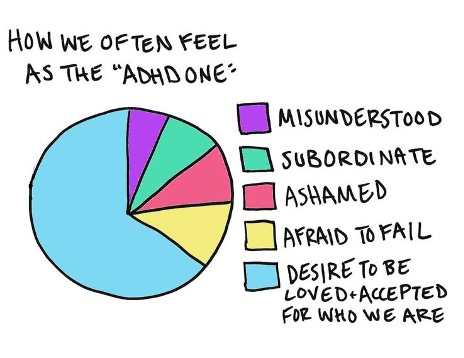
The stigma of neurodiversity is real, which is why it feels so important for me to challenge and dispel these binary and careless opinions which are not facts, but to the untrained eye could look like they are, especially when written by professionals in whom we often give our trust.
This article/opinion piece seeks to test the proposed hypothesis – ‘does ADHD persist into adulthood’? I think we can safely say that both these men, have already concluded that they believe it doesn’t, and so have sought to scavenge for any academic breadcrumbs which may back up their forgone conclusion.
They claim that research from retrospective studies previously undertaken, and commonly cited (which suggests that 50% – 60% of childhood ADHD persists into adulthood – proving their hypothesis wrong) has been disproven by prospective studies, which they state repeatedly show that 80% of children with ADHD do not continue to have that ‘diagnosable condition’ or ‘continue to meet the criteria for diagnosis into adulthood’. The studies they use for this bold claim are weak, and full of bias (mainly citing their own work, gender weighted studies and differing diagnostic tools).
The statistics and so-called evidence they cite is in my opinion limited, misleading, misinformed, bias, and lacks a clear and robust evidence base which has a reliable and representative sample size and includes differing socio demographics and accounts for gender disparities, and inequalities of an outdated diagnostic criterion. The article argues that adult ADHD is not a scientifically valid diagnosis and that a careful review of the scientific literature reveals that the range of ADHD like symptoms in adults is more accurately explained by other empirically (woohoo first academic word in the article) validated psychiatric disorders such as mood disorders, (coincidentally the specialist area of the psychiatrist who cited his own work…hmm).
Here’s my whistle stop tour of where I think their ‘opinion’ is unreliable and their evidence limited.
The main ‘evidence’ is drawn from two articles (if we exclude the one written by the author previously).
One
A study from 2016, which sought to investigate whether impaired young adults with ADHD symptoms always have a childhood-onset disorder in a population-based longitudinal study. The cohort were from a town in Brazil from and were assessed for ADHD symptoms at age 11 and then followed up at age 18-19. The limitations within this study included:
- ADHD status was first asserted at 11 years of age using a screening tool called ‘hyperactivity sub scale of strengths and difficulties questionnaire’. The 18 – 19 young adults ADHD diagnosis was derived using DSM-5 criteria. Additionally, the young adult cohort used self-reporting (unreliable at that age) vs children aged 11 who had a combined approach including a more structured approach and other assessments such as parents.
- Using a hyperactivity screening tool in 1993 at age 11 assumes that hyperactivity was present in all their diagnosis of ADHD, which we know now is incorrect as many children and adults with ADHD have one of three types (Hyperactive and Impulsive/Inattentive/Combined) and therefore those without hyperactivity as a symptom would not be given a diagnosis (most likely girls).
- Latest evidence also suggests that people who are diagnosed with ADHD in childhood who have more hyperactive/inpulsive symptoms are likely to demonstrate more inattentive symptoms as they age, as hyperactivity reduces and often changes from being external to internal (moving and fidgeting to over thinking and being hyperactive in thoughts as an example).
- DSM-5 Criteria was used in the 18-19 group which is a set of 18 criteria (nine hyperactive/Impulsive and nine Inattentive) the criteria were designed for children, yet even to this day we still use this to assess adults. Traits which we know are common amongst adults with ADHD such as Rejection Sensitive Dysphoria (RSJ) and Emotional Dysregulation are currently not part of the DSM-5. However, Russell Barkley in his book ‘Taking Charge of Adult ADHD’ recommends a newer criterion for adults which consists of 9 traits and is more reliable and up to date.
- ADHD diagnosis was predominantly male gendered in the children study, and this is most likely because boys tend to have more hyperactive symptoms. The screening tool focused on hyperactivity and therefore more inattentive traits of ADHD, which are more prevalent in girls, wouldn’t have been flagged up. We now know that many children, in particular girls are undiagnosed until adulthood because of entrenched stereotypes of what ADHD looks like and this proliferated by professionals in the field such as the authors of this article.
Two
The authors of the article also cite a second research study to back up their argument, a study from 2012 which aims to understand if children diagnosed as having ADHD have worse education, occupational, economic, societal, marital outcomes and higher rates of ongoing ADHD and associated challenges compared to non-ADHD, 33 years later. The context of the study was that ‘prospective studies of childhood attention-deficit/hyperactivity disorder (ADHD) have not extended beyond early adulthood’ and therefore sought to take a longer view of the impact.
- This study was a 33 year follow up comparative study. The cohort consisted of 135 white men with ADHD in childhood and 136 men without ADHD. Very gender biased.
- The study notes that these prospective studies have not gone beyond the third decade of life and that any information after that age is inferred.
- Two cohort of boys were referred by teachers between 1970 and 1978, hyperactive with behavioural challenges vs a comparison group of boys without ADHD and whose school charts noted unremarkable behaviour. Follow up at 33 years suggested that ADHD was significantly more prevalent in the ADHD children’s cohort than the comparison group.
- The study concluded that children with ADHD go on to have worse outcomes in life.
I’m unsure why they used this study to try and evidence that ADHD does not persist into adulthood when there is a clear correlation.
Going back to the opinion piece in September last year, the authors conclude that ‘the history of psychiatry teaches us that the field has been vulnerable to a host of diagnostic fads. Adult ADHD is the latest of such fads’. It might be worth noting at this point that neither of these authors are ADHD specialists, it could be suggested that their expertise in the field is not valid and that their insistence and conclusion that ADHD symptoms better meet the criteria and diagnosis of their own specialist interests ‘mood disorders’ is clearly bias. More reliable data such as a study by Sibley et al in 2022, cited by Ramsey J 2023 concluded in a more robust study that 90% of children with ADHD have residual symptoms into adulthood.
Articles written, by what would appear on the surface as credible practitioners such as this, are stigmatising, harmful and damaging to adults who have ADHD.
ADHD diagnosis is on the increase, Dr Tony Lloyd, CEO of the ADHD foundation, suggested a 400% increase in the number of adults seeking a diagnosis since 2020. The utter nonsense that this is a fad in psychiatry is detrimental. Having adult ADHD can be debilitating at times, it leads to people feeling incapable of levelling with other adults’ abilities, prevents people from thriving at work, damages relationships and friendships and causes depression as well as an increased risk of suicide.
The rise in diagnosis is not due to it being ‘Du Jour’ it is due to ‘une sensibilisation accrue’ and ‘remettre les stéréotypes’. Writing in French doesn’t change an evidence base, it just makes inaccuracies seem more interesting!
 Ramblings…
Leave a comment